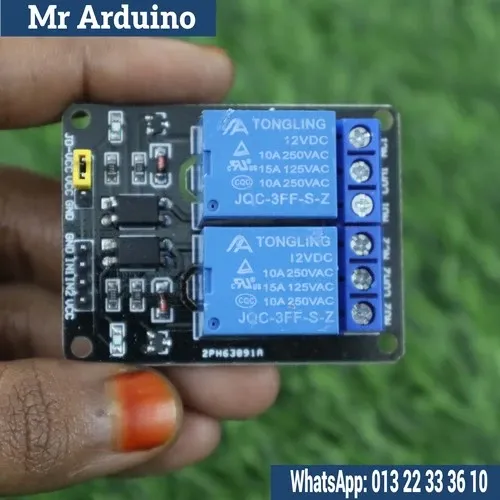
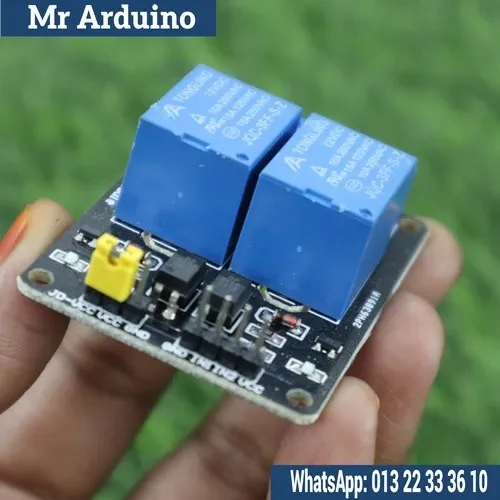
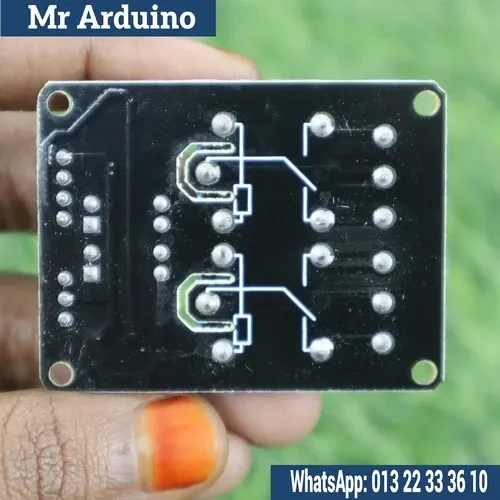
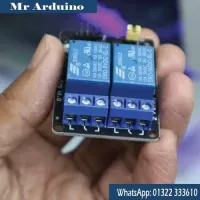
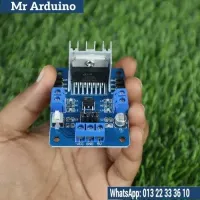
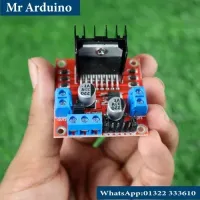
The 12V 2-Channel Relay Module is a versatile and essential electronic component that allows microcontrollers, such as Arduino or Raspberry Pi, to control high-voltage or high-current devices through low-voltage control signals. This module contains two relays, which can act as switches to control external devices like motors, lights, fans, or other AC/DC appliances. The relays operate on a 12V DC input, but they can switch higher voltage AC or DC circuits (typically up to 250V AC or 30V DC), allowing you to control large appliances or industrial systems safely and efficiently.
This module is commonly used in automation systems, home automation, security systems, robotics, and any project requiring the switching of high-power devices through a microcontroller.
How It Works:
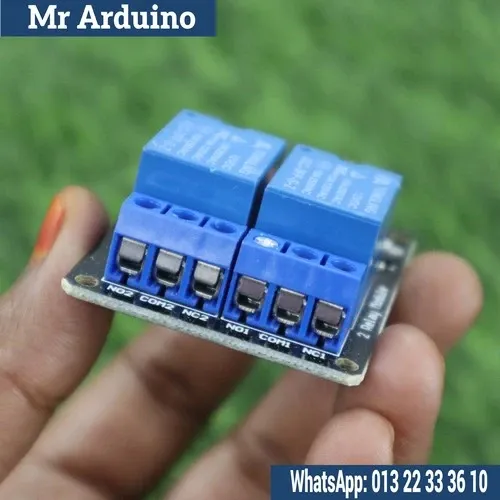
The 12V 2-Channel Relay Module works by receiving a low-voltage control signal (typically 5V or 3.3V from a microcontroller) to control the switching of a 12V DC input. Each relay has two primary states: normally open (NO) and normally closed (NC).
- Relay Control: When a low-voltage signal is applied to the control pin, the relay's internal switch toggles, either closing or opening the connection between the COM (common) and the NO or NC terminals.
- NO (Normally Open): When the relay is not energized, the connection between COM and NO is open (disconnected). When the relay is activated, it closes the circuit between COM and NO, allowing current to flow.
- NC (Normally Closed): When the relay is not energized, the connection between COM and NC is closed. When activated, the relay opens the circuit between COM and NC, breaking the connection.
Key Features:
- Dual Relay Channels: The module has two separate relay channels, each capable of controlling an independent device, allowing you to control two high-power devices simultaneously.
- 12V DC Control: Operates with a 12V DC control signal, making it compatible with a wide range of control systems, especially in automotive or industrial applications.
- High Switching Capacity: The relay can control devices operating on up to 250V AC or 30V DC, making it suitable for controlling a variety of high-power appliances.
- Optocoupler Isolation: Often includes an optocoupler for electrical isolation between the low-voltage control circuit and the high-voltage relay circuit, enhancing safety and preventing damage to the microcontroller or other sensitive components.
- Easy Integration: Compatible with common microcontrollers, such as Arduino, Raspberry Pi, and ESP32, with simple connection via the IN pins for control.
- Indicator LEDs: Typically includes LEDs for each relay to indicate when the relay is activated, providing visual feedback of relay status.
- Solid-State Design: Features reliable, solid-state relays for long-lasting operation with minimal mechanical wear.
Specifications:
- Relay Type: SPDT (Single Pole Double Throw) relays, with NO and NC contacts.
- Control Voltage: 12V DC (for powering the relay module)
- Switching Voltage:
- AC: Up to 250V AC at 10A
- DC: Up to 30V DC at 10A
- Operating Current: < 70mA (per relay when active)
- Trigger Voltage for Relay: Typically 5V DC or 3.3V DC on the input pins from the microcontroller.
- Input Pins: 2 input pins (one per relay channel) for control.
- Size: Varies but typically around 5 cm x 3.5 cm for the 2-channel module.
- LED Indicators: Usually two LEDs (one per relay) to indicate the relay's on/off state.
- Optocoupler: Provides electrical isolation to protect the low-voltage circuitry.
Applications:
- Home Automation: Automating lights, fans, or other household devices through a microcontroller or home automation system.
- Industrial Automation: Controlling motors, pumps, and other industrial equipment in a factory or lab environment.
- Robotics: Allowing robots to control high-power devices such as motors or solenoids.
- Security Systems: Triggering alarms, lights, or cameras based on sensor inputs.
- IoT Projects: Enabling smart devices to switch high-power electronics remotely through internet connectivity.
- Remote Control Systems: Controlling appliances or devices remotely via wireless communication (e.g., through Wi-Fi or Bluetooth).
Limitations:
- Limited Switching Capacity: While the relay can handle up to 10A, it may not be suitable for very high-power applications, like heavy-duty industrial machinery or large HVAC systems. Make sure to verify the required current and voltage before usage.
- Relay Mechanical Life: Mechanical relays, while reliable, do wear out over time with repeated switching cycles. In high-frequency or high-load applications, it may be necessary to consider solid-state relays.
- Noise and Interference: The activation of the relay can cause electrical noise or spikes in the system, so proper filtering or decoupling may be required, especially in sensitive circuits.
- Power Consumption: The module requires a 12V DC power source, which may not be ideal for all projects, especially those operating on low-voltage power supplies (e.g., 5V systems).
The 12V 2-Channel Relay Module is an excellent solution for projects requiring the control of high-voltage or high-current devices using low-voltage signals. Its easy integration with microcontrollers and ability to control a wide range of electronic devices makes it ideal for home automation, robotics, industrial applications, and more.