Your cart is empty, and it looks like you haven’t added anything yet.
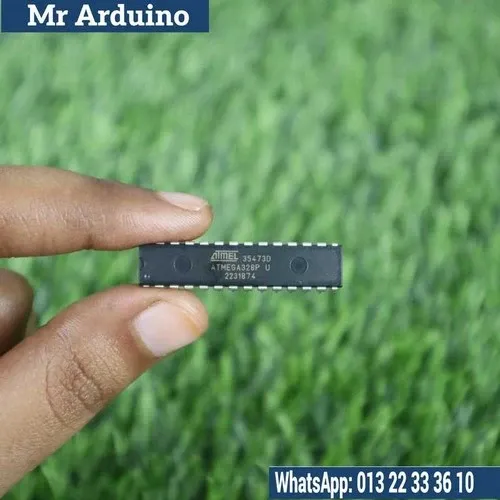
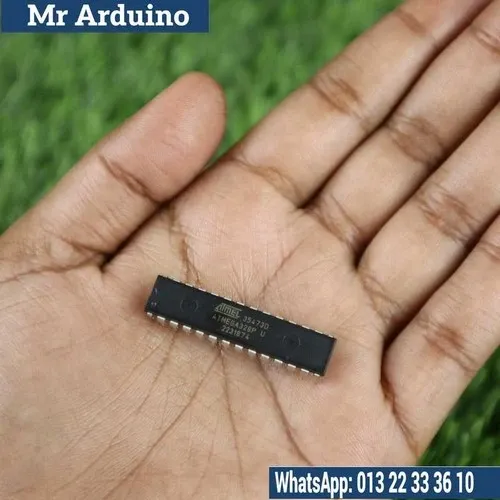
The ATmega328P is an 8-bit AVR microcontroller developed by Microchip Technology, widely used in embedded systems, electronics projects, and Arduino-based applications. It is known for its compact design, low power consumption, and versatility. The ATmega328P is the heart of the popular Arduino Uno board, and it is often used in a wide range of applications from DIY projects to industrial systems.
With a 32KB Flash memory, 2KB SRAM, and 1KB EEPROM, the ATmega328P is capable of executing complex tasks while consuming minimal power, making it ideal for battery-operated devices and low-power applications. It features a wide array of I/O pins, timers, and communication protocols such as UART, SPI, and I2C, which allow for easy integration with external components and sensors.
Key Features:
Architecture: 8-bit AVR
Operating Voltage: 2.7V to 5.5V
Flash Memory: 32KB (with 0.5KB reserved for bootloader)
SRAM: 2KB
EEPROM: 1KB
Clock Speed: Up to 20 MHz
I/O Pins: 23 General Purpose I/O pins
Timers: 3 timers (8-bit and 16-bit timers)
Communication Protocols: UART (Universal Asynchronous Receiver Transmitter), SPI (Serial Peripheral Interface), I2C (Inter-Integrated Circuit)
ADC (Analog to Digital Converter): 10-bit ADC with 8 channels (for reading analog sensors)
PWM (Pulse Width Modulation): Up to 6 channels of PWM for controlling motors, LEDs, etc.
Watchdog Timer: Built-in watchdog timer for system stability.
Interrupts: External interrupts and programmable interrupts
Package Types: Available in DIP-28, TQFP-32, and other packages for flexibility in design.
Applications:
DIY Electronics Projects: The ATmega328P is the core of many DIY electronics projects, especially when combined with the Arduino platform. It is widely used in home automation, robotics, wearable devices, and IoT applications.
Arduino Boards: The ATmega328P is the microcontroller on the Arduino Uno, one of the most popular development boards for hobbyists and professionals.
Sensors & Actuators: It can interface with a variety of sensors (temperature, humidity, light, etc.) and actuators (motors, servos, relays) for automation and control applications.
Robotics: Due to its efficient I/O and communication capabilities, it is widely used in robotic control systems.
Low-Power Applications: The ATmega328P's low power consumption makes it a great choice for battery-powered devices, such as remote sensors, monitoring devices, and other portable systems.
Prototyping and Development: Ideal for rapid prototyping of electronic systems in prototyping boards like breadboards.
How It Works: The ATmega328P operates by processing digital signals (high or low voltage) through its general-purpose I/O pins and executing instructions that control other parts of the system, such as sensors, motors, or communication modules. Here's a basic breakdown of how it works:
Microcontroller Initialization: When powered on, the ATmega328P starts executing instructions from its program memory (Flash). The program is stored in the 32KB Flash memory, and the microcontroller runs this program to control the system's operation.
Analog to Digital Conversion (ADC): The ATmega328P includes a 10-bit ADC, which can convert analog voltages from sensors into digital values, making it possible to read temperature or light levels, for example. The microcontroller can process these readings to make decisions or perform actions.
Digital I/O and Control: The ATmega328P has 23 I/O pins that can be configured as input or output. These pins can read digital signals (high or low) or send control signals to actuators (like motors, LEDs, etc.) or external devices.
PWM and Timers: The ATmega328P supports PWM (Pulse Width Modulation), which can generate a variable-duty cycle signal on certain pins, making it suitable for controlling the brightness of LEDs, the speed of motors, or the position of servos. It has three timers that can handle tasks like delays, timing operations, and frequency generation.
Communication (UART, SPI, I2C): The microcontroller can communicate with other devices through UART, SPI, or I2C. For instance, it can send and receive data from sensors, displays, and other microcontrollers. This allows integration of the ATmega328P in more complex systems, such as IoT networks or distributed control systems.
Bootloader and Programming: The ATmega328P can be programmed via a serial interface (UART) using a bootloader. The bootloader allows users to upload programs without needing external programmers. This feature is particularly useful in development boards like Arduino, where users can upload their sketches via USB directly to the microcontroller.
Low-Power Operation: The ATmega328P supports low-power modes, allowing it to consume less power when idle, which is essential for battery-operated applications. It includes sleep modes where the processor and peripherals can be turned off to save power.
Product Limitations:
Memory Constraints: With 32KB Flash, 2KB SRAM, and 1KB EEPROM, the ATmega328P is not suitable for large-scale applications or systems requiring significant memory and processing power. For more complex applications, higher-memory microcontrollers may be needed.
Processing Power: The 8-bit AVR architecture provides good performance for many tasks but may not be fast enough for high-speed processing or complex real-time tasks.
No Direct Ethernet or Wi-Fi Support: While the ATmega328P can interface with Wi-Fi modules (like ESP8266), it does not have built-in support for Ethernet or Wi-Fi, making it less suitable for networked applications without additional components.
Conclusion: The ATmega328P Microcontroller is a popular 8-bit AVR microcontroller that is perfect for a variety of low-to-medium power applications. With its 32KB Flash memory, 2KB SRAM, and 1KB EEPROM, it is capable of handling tasks like sensor interfacing, motor control, signal processing, and communication in embedded systems and Arduino-based projects.
Its low power consumption, easy programming (via Arduino IDE), and versatility make it an excellent choice for DIY electronics, prototyping, and hobbyist projects. However, for applications that require more processing power, memory, or networking capabilities, a more advanced microcontroller might be necessary.
No review given yet!
Fast Delivery all across the country
Safe Payment
7 Days Return Policy
100% Authentic Products
You need to Sign in to view this feature
This address will be removed from this list