Your cart is empty, and it looks like you haven’t added anything yet.
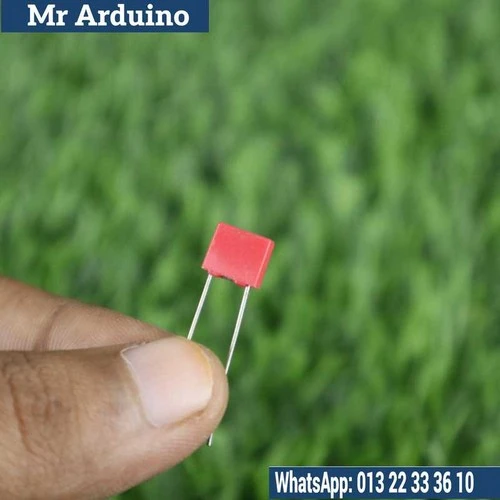
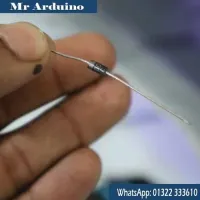
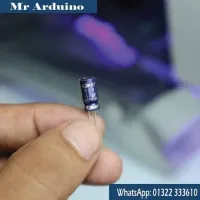
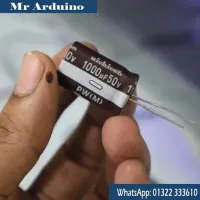
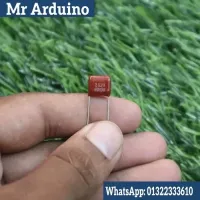
The 104J 100V Ceramic Capacitor is a high-quality general-purpose ceramic capacitor designed for a wide range of electronic applications that require moderate voltage and moderate capacitance. The 104 in the part number refers to the capacitance value of 100nF (100,000 pF), while the "J" denotes a tolerance of ±5%, meaning the capacitance can vary by up to 5% from its nominal value. The 100V voltage rating indicates that the capacitor is capable of withstanding voltages up to 100V without failure, making it ideal for applications involving low to medium voltage levels.
This ceramic capacitor is often used in filtering, coupling, and decoupling circuits and is suitable for low-voltage DC circuits, AC systems, and signal processing applications.
Key Features:
Capacitance: 100nF (100,000 pF), suitable for filtering, decoupling, and noise suppression in low-to-medium voltage circuits.
Voltage Rating: 100V, designed to handle voltages up to 100V, making it suitable for low to medium voltage circuits.
Tolerance: ±5% tolerance, meaning the actual capacitance may vary within 5% of the stated value, which is acceptable for many general-purpose uses.
Material: Ceramic dielectric, which is durable, reliable, and cost-effective for general-purpose applications.
Size and Packaging: Small form factor suitable for use in printed circuit boards (PCBs) and compact electronics.
Temperature Stability: Typically operates in the range of -25°C to +85°C, depending on the material type, providing stability in most standard environmental conditions.
Applications:
Power Supplies: The 104J 100V Ceramic Capacitor is commonly used in AC/DC power supplies to filter out ripple voltages and stabilize the output of the power source.
Signal Coupling and Decoupling: Used in signal coupling circuits to allow AC signals to pass through while blocking DC components. It is also used in decoupling applications to reduce noise and smooth voltage in power supplies for sensitive components.
Noise Suppression: The capacitor helps suppress high-frequency noise in both DC and AC circuits, ensuring that the voltage delivered to components is smooth and stable.
Filtering Circuits: The 100nF capacitance is suitable for use in low-pass filters or high-frequency signal filters where it can smooth out fluctuations or eliminate unwanted high-frequency noise.
Oscillator Circuits: Often used in oscillators and timing circuits where stable capacitance is needed to ensure consistent operation and frequency generation.
Industrial Equipment: Employed in industrial control systems and automated machinery for voltage smoothing and signal processing applications.
Consumer Electronics: Found in various consumer electronics such as audio devices, smartphones, power adapters, and LED lighting, where filtering and decoupling are needed.
How It Works: The 104J 100V Ceramic Capacitor operates on the principle of electrostatic energy storage. Here's how it works in a circuit:
Energy Storage: When voltage is applied across the terminals of the capacitor, the electric charges accumulate on the two conductive plates of the capacitor. The ceramic dielectric material between the plates acts as an insulator, allowing the capacitor to store energy in the form of an electrostatic field.
Filtering and Smoothing: In power supply circuits, the capacitor stores energy during periods of voltage excess and releases it during periods of voltage drop. This helps smooth out voltage fluctuations and reduces ripple in the output voltage of the power supply.
Decoupling and Noise Suppression: The capacitor provides a low-impedance path to ground for high-frequency noise signals while allowing DC or low-frequency signals to pass through unaffected. This is why ceramic capacitors are often used for decoupling in circuits to filter out unwanted noise and ensure stable power to sensitive components.
Signal Coupling: In signal coupling, the capacitor allows alternating signals (AC) to pass between different stages of a circuit while blocking direct current (DC). This is particularly useful in audio circuits, communication systems, and signal processing systems.
Energy Release and Storage Cycle: As the capacitor charges and discharges, it maintains a stable voltage across its terminals, providing energy storage and voltage regulation throughout the circuit.
Voltage Rating and Durability: The 100V voltage rating ensures the capacitor can handle typical voltage levels in low- to medium-voltage circuits without breaking down. It can handle short-duration voltage spikes and transient conditions up to 100V.
Product Limitations:
Tolerance: The ±5% tolerance may not be suitable for applications where precision capacitance is critical, such as timing circuits or high-frequency circuits where exact capacitance is necessary.
High-Frequency Performance: Like most ceramic capacitors, the 104J 100V may experience performance degradation at high frequencies due to its parasitic inductance and the nature of the ceramic material.
Temperature Sensitivity: Ceramic capacitors can experience a slight change in capacitance with temperature fluctuations. The temperature coefficient varies depending on the type of ceramic material used, which could affect performance in applications requiring precise capacitance.
Not Ideal for High-Precision Applications: While excellent for general purposes, the 104J 100V may not be the best choice for high-precision or high-frequency applications, where other capacitor types like film capacitors or tantalum capacitors might be preferred.
Conclusion: The 104J 100V Ceramic Capacitor is a reliable, versatile component perfect for low- to medium-voltage applications where filtering, decoupling, voltage stabilization, and signal coupling are required. Its 100nF capacitance and 100V voltage rating make it an excellent choice for a wide range of consumer electronics, power supplies, and industrial circuits.
Its compact size, low cost, and durability make it ideal for general-purpose applications in many electronic devices. However, for applications requiring high precision, high-frequency stability, or temperature sensitivity, more specialized capacitors might be more appropriate.
Let me know if you have any further questions or need more details!
No review given yet!
Fast Delivery all across the country
Safe Payment
7 Days Return Policy
100% Authentic Products
You need to Sign in to view this feature
This address will be removed from this list