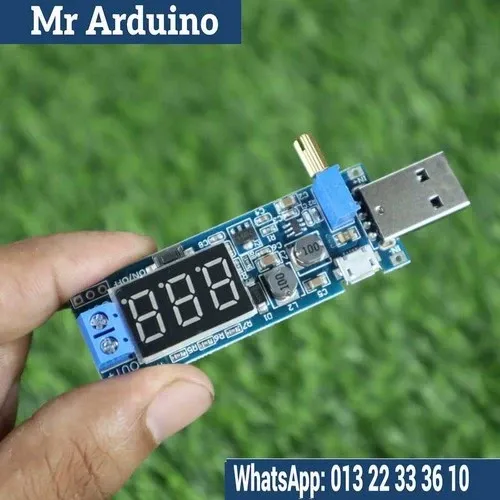
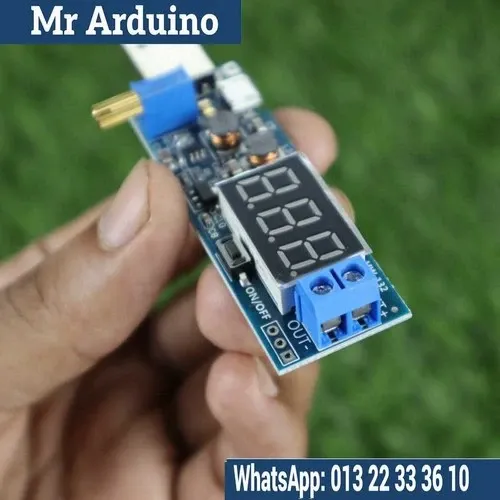
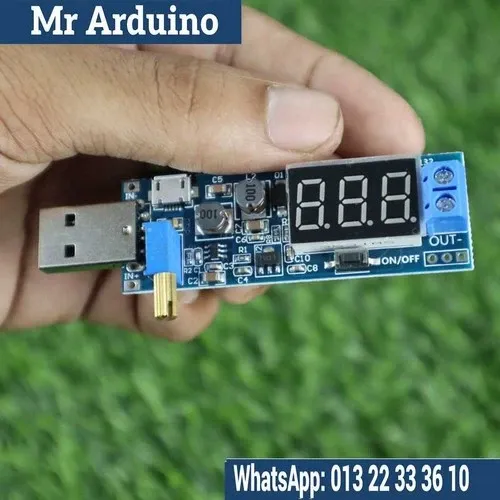
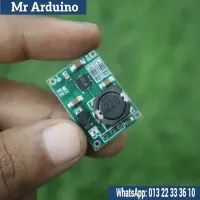
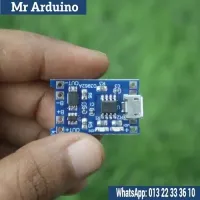
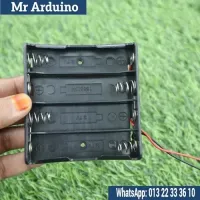
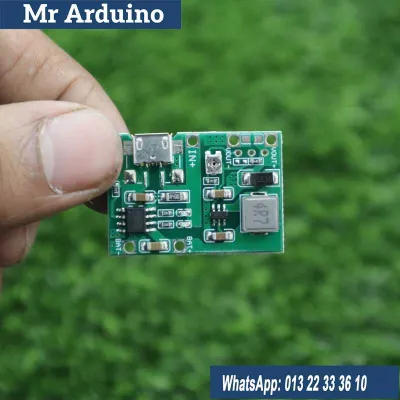
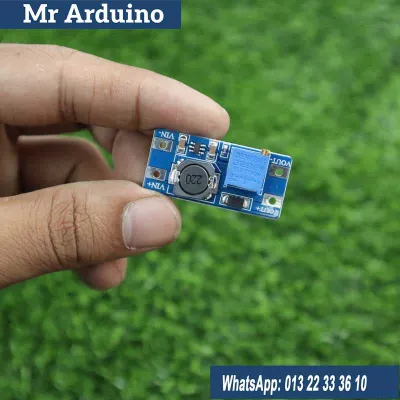
The USB Buck Booster Module is a versatile power conversion module designed to step down (buck) or step up (boost) voltage from a USB power source (typically 5V) to a range of higher or lower voltages for powering a variety of devices. This module is primarily used to convert USB power (5V) into different voltage levels, offering flexibility in powering electronic components, batteries, or systems that require either a higher or lower voltage than 5V.
It is an essential component for portable electronics, battery-powered systems, and DIY projects that rely on USB as the main power source but require non-5V voltages for their operation.
How It Works:
The USB Buck Booster Module is built around a DC-DC converter, which integrates both buck and boost functionality. It allows the input voltage (from 5V USB) to be adjusted either up or down depending on the required output.
- Boost Function (Step-Up): If a higher output voltage is needed (e.g., 9V, 12V, 24V), the module uses the boost function to increase the 5V input to the required voltage.
- Buck Function (Step-Down): If a lower output voltage is needed (e.g., 3.3V, 1.8V), the module uses the buck function to reduce the 5V input to the desired lower voltage.
- Voltage Adjustment: Many modules include an adjustable potentiometer that allows you to fine-tune the output voltage to suit your needs.
By controlling the pulse-width modulation (PWM) signal, the module efficiently converts the power with minimal energy loss, ensuring the device remains cool and operates reliably.
Key Features:
- Wide Input Voltage Range: Typically accepts 5V from a USB source (which is standard for most power banks, chargers, or USB ports).
- Adjustable Output Voltage: Can provide a range of output voltages depending on the application, typically ranging from 1.5V to 12V (or more).
- Dual Functionality (Buck and Boost): Can either step up or step down the input voltage, providing great flexibility for powering different types of devices.
- Compact Design: Small and lightweight, making it ideal for portable applications where space is limited.
- High Efficiency: Uses a DC-DC converter for efficient voltage conversion, usually with an efficiency of around 85%-95%, reducing energy loss and heat generation.
- LED Indicator: Often includes an LED to indicate power on/off or provide visual feedback of the module's status.
- Protection Features: Many modules are equipped with overcurrent protection, short-circuit protection, and thermal shutdown for safe and reliable operation.
Specifications:
- Input Voltage: 5V (USB input)
- Output Voltage: Adjustable, typically 1.5V to 12V (or higher, depending on the module design)
- Output Current: Depends on the module and voltage difference, but usually ranges from 1A to 3A.
- Efficiency: 85% - 95% (depending on input-output voltage difference)
- Input Power: USB-powered (using a USB A to Micro USB cable or directly through a USB port).
- Size: Varies, but typically compact (around 5 cm x 2.5 cm).
- Operating Temperature Range: Typically -40°C to +85°C.
- Adjustable Potentiometer: For tuning the output voltage.
- Protection: Overload, overcurrent, and short-circuit protection.
Applications:
- Portable Electronics Projects: Powering small devices such as microcontrollers (Arduino, ESP32, Raspberry Pi), sensors, or low-power components from a USB power source.
- Powering Rechargeable Batteries: Used in solar charging systems or portable battery chargers to boost or step down voltage to charge Li-ion, LiPo, or other types of rechargeable batteries.
- Powering LED Strips: Ideal for driving LED strips that require higher voltages than USB (e.g., 12V or 24V LED strips).
- Robotics: Providing the necessary voltage for motors, sensors, and other components in a robotic system powered by a USB power bank or port.
- DIY Projects: Used for powering a wide range of DIY electronics and embedded systems, especially where USB is the primary power source.
- Arduino and Raspberry Pi: Ideal for projects where your development board requires a different voltage than the 5V provided by the USB port.
Limitations:
- Current Draw: The module can only supply as much current as it can efficiently convert based on the input power. For example, if you're boosting voltage, the available current on the output side will be less than the input current at the same power level.
- Heat Generation: At higher current outputs or large voltage differences (e.g., stepping from 5V to 12V), the module may generate heat. It may require a heat sink for higher-power applications.
- Output Voltage Limits: Some modules may have limited voltage range for the boost or buck feature, and extreme voltage adjustments may not be achievable depending on the module’s design.
- Voltage Ripple: Some modules, especially lower-quality ones, may have voltage ripple at high currents or high output voltages, which could affect sensitive components.
The USB Buck Booster Module is an excellent choice for any project that requires versatile and efficient power conversion. Its ability to step up or step down voltage from a USB source makes it ideal for powering a wide range of devices and projects, ensuring a stable and reliable power supply in a compact form factor.